src.timed_net package
Summary
This simulations implements a temporal-aware PT net by attaching time information to the PT net tokens. It simulates a supply chain depending on two component producers and an assembler.
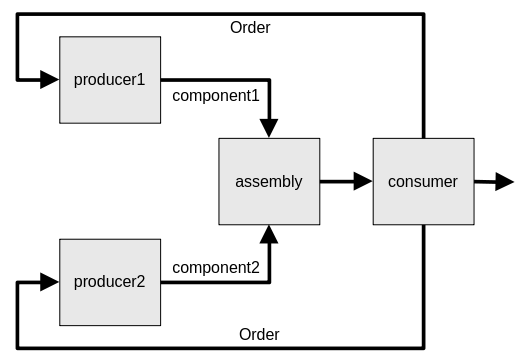
In the diagram,
producer1buildscomponent1in a time interval approximated by a normal distribution \(\mathcal{N}(\mu_1, \sigma_1)\) with the mean \(\mu_1\) and standard deviation \(\sigma_1\) seconds.Similarly
producerbuildscomponent2in a time interval of \(\mathcal{N}(\mu_2, \sigma_2)\)The components are assembled and served to the consumer.
Lastly, the consumer places a new order to the producers.
The picture below is the auto-generated PT net diagram by SoyutNet.
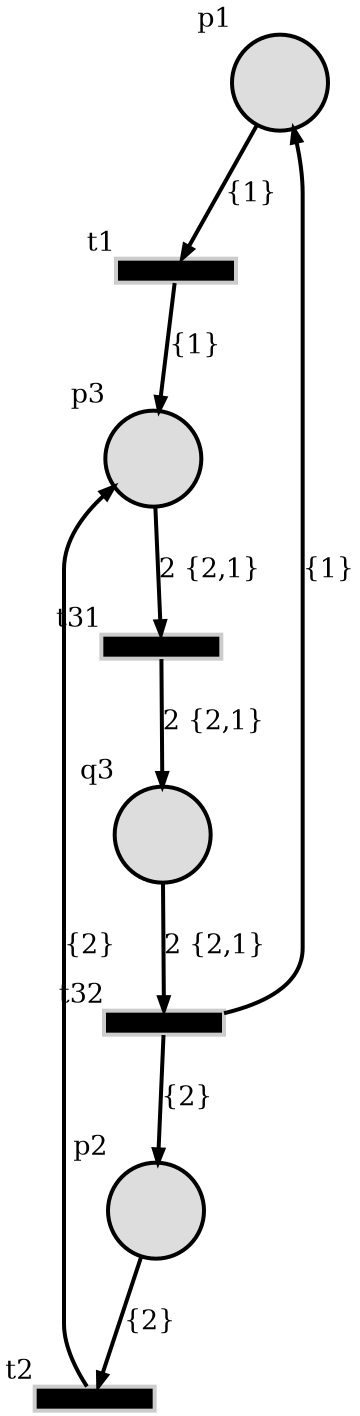
p1andt1define the producer1.p2andt2define the producer2.t31is the assembler.p3is the consumer.The component1 and 2 are labeled by
{1}and{2}.
System description
SoyutNet tokens are represented by a tuple of integers.
token: tuple[int, int] = (label, id)
Time information is embedded into the second item (id) of token.
Simulation starts with an initial token at the producers
produer1has(PRODUCER1_LABEL, T0)produer2has(PRODUCER2_LABEL, T0)
where T0 = 0 (secs) initially. Each producer adds a random integer distributed by
\(\mathcal{N}(\mu_i, \sigma_i)\), \(i \in {1,2}\) at a
(TimedTransition) instance then sends to their output arcs.
121
122    class TimedTransition(soyutnet.Transition):
123        def __init__(self, name, rng_params, *args, **kwargs):
124            super().__init__(name=name, net=net, *args, **kwargs)
125            self._rng_params = rng_params
126
127        def _delay(self):
128            return round(random.gauss(*self._rng_params))
129
130        async def _process_tokens(self):
131            for label in self._tokens:
132                ids = self._tokens[label]
133                self._tokens[label] = list(map(lambda x: x + self._delay(), ids))
134                """Add producer delay"""
135
136            return await super()._process_tokens()
137
The assembler receives tokens, redirects to the consumer. The total duration of this process is the maximum of the delay introduced by producers.
141
142    class CombinerTransition(soyutnet.Transition):
143        def __init__(self, *args, **kwargs):
144            super().__init__(net=net, *args, **kwargs)
145            self.arrival_time = []
146
147        async def _process_tokens(self):
148            max_id = 0
149            arrivals = [0, 0]
150            for label in self._tokens:
151                ids = self._tokens[label]
152                arrivals[label - 1] = max(ids)
153                if ids:
154                    max_id = max(max_id, arrivals[label - 1])
155            for label in self._tokens:
156                self._tokens[label] = [max_id] * len(self._tokens[label])
157                """Total delay is the max of two branches"""
158
159            self.arrival_time.append(arrivals)
160
161            return await super()._process_tokens()
162
The consumer places an other order to the producers after receiving the token. At each cycle, the token IDs are incremented.
The tokens are counted by the consumer and the timings are saved.
533
534    production_time = TimeInstants()
535    Ti = lambda k: production_time[k - 1]
536    controller = Controller(production_time=production_time)
537    converged = asyncio.Condition()
538
539    async def stock_counter(tr):
540        nonlocal production_time, converged
541        t = None
542        for label in tr._tokens:
543            ids = tr._tokens[label]
544            if not ids:
545                continue
546            for id in ids:
547                if t is None:
548                    t = id
549                    production_time.append(t)
550                else:
551                    assert t == id
552
553        dT = Ti(0) - Ti(-1)
554        controller.measure(dT)
555        u = controller.advance()
556        """
557        Measured production time and generated the amount of new order delays ``u``.
558        u = (dt1, dt2) means that new order to producer1 and 2 will be placed after
559        dt1 and dt2 seconds.
560        """
561        if controller.is_done():
562            """If simulation is done inform the canceller."""
563            async with converged:
564                converged.notify_all()
565
566        for i in range(2):
567            """Postpone orders."""
568            label = i + 1
569            assert len(tr._tokens[label]) == 1
570            tr._tokens[label][0] += u[i]
571
572        return True
573
The whole implementation can be found at https://github.com/dmrokan/soyutnet-simulations/blob/main/src/timed_net/main.py
Joint probability distribution
The total duration of the described process is distributed according to
The mean and variance of \(X\) is given as
where \(\Phi\) and \(\phi\) are the CDF and PDF of normal random distribution [nadarajah2008].
20
21
22def pdf(x, mean=0, std=1):
23    """phi"""
24    var = std**2
25    a = 2 * math.pi * var
26    a = 1 / (a**0.5)
27    return a * math.exp(-((x - mean) ** 2) / (2 * var))
28
29
30def cdf(x, mean=0, std=1):
31    """Phi"""
32    a = 2**0.5
33    return 0.5 * (1 + math.erf((x - mean) / (std * a)))
34
35
Real-time moment estimation
The moments \(E[X], E[X^2]\) and variance \(Var[X]\) can be estimated by dynamic averaging of observed random variable \(x_n\).
For this purpose, a special list class NormalSamples is implemented.
244
245    relative_error = lambda a, b, c=1 / (2**BIT_WIDTH - 1): abs((a - b) / (b + c))
246
247    class NormalSamples(UserList):
248        def __init__(
249            self,
250            *args,
251            eps=1e-2,
252            convergence_condition=10,
253            rng_params=None,
254            validate_conv=False,
255        ):
256            super().__init__(*args)
257            self._eps = eps
258            self._moments = None
259            self._variance = Qp.tuple((0, eps, 0.0))
260            self._cc = convergence_condition
261            self._rng_params = None
262            if rng_params is not None:
263                self.set_rng_params(rng_params)
264            self._max_size = 600 * 1024 * 1024
265            self._initialize_moments()
266            self._iter = 0
267            self._validate_conv = validate_conv
268            if validate_conv:
269                self._last_n_dmu = Qp.list([0] * self._cc)
270                self._last_n_dvar = Qp.list([0] * self._cc)
271
As products arrive, the difference between the ordering time and arrival time is
calculated. When this delta time is appended to the NormalSamples, it automatically
updates moments and variance.
287
288        def _update_moment(self, moment, val):
289            moment = Qp.tuple(moment)
290            if abs(val) < 1e-2 * self._eps:
291                """Ignore very small numbers in statistics"""
292                return moment
293            l = len(self)
294            mu, eps, eps0 = moment
295            if l % self._cc == 0:
296                eps0 = 0.0
297            mu_prev = mu
298            mu = (mu * l + val) / (l + 1)
299            dmu = relative_error(mu_prev, mu)
300            eps = (eps * l + dmu) / (l + 1)
301            eps0 = max(eps0, eps)
302            assert isinstance(mu, Qp)
303            assert isinstance(eps, Qp)
304            assert isinstance(eps0, Qp)
305            """
306            Save the max of last self._cc samples which
307            will be used for deciding convergence later.
308            """
309
310            return (mu, eps, eps0)
311
If last N samples are very close to each other distrbution,
the NormalSamples instance informs about convergence.
muis the estimate of moment calculated by dynamic averaging.epsthe average change in current and previousmu.eps0is the max of lastself._ccnumber ofepsvalues which is used to determine convergence.
Estimate producer delays
The problem is developing an algorithm to estimate the producer delays separately by using the difference between the time a new order is placed and the time when the product is received.
System model
A simple model of the producer/consumer flow can be
\(n\) is the product counter starting from zero.
\(x_i\) is the production time of component_i.
\(w_i\) is a Gaussian random variable, \(E[w_i] = \mu_i, Var[w_i] = \sigma_i^2\).
\(y = x\) is the total production observed by the consumer, \(E[y] = \mu, Var[y] = \sigma^2\).
\(u_i (sec)\) denotes postponing the orders by the consumer. It is assumed that the consumer can schedule orders for later instead of placing them immediately.
The units are seconds.
State machine observer/controller scheme
The observer/controller scheme runs a few tests on the producer/consumer flow. The order of tests are implemented as a state machine with the states below
409
410    class State(Enum):
411        OBSERVE_JOINT_DIST = auto()
412        TEST_PRODUCER1 = auto()
413        TEST_PRODUCER2 = auto()
414        ESTIMATE_DELAYS = auto()
415        DONE = auto()
416
OBSERVE_JOINT_DIST: Estimate joint mean (\(\mu\)) and variance (\(\sigma\)).TEST_PRODUCER1: Find out producer1’s response by postponing orders.TEST_PRODUCER2: Find out producer2’s response by postponing orders.ESTIMATE_DELAYS: Calculate the difference between \(\mu_1\) and \(\mu_2\) approximately.DONE: Exit simulation.
The state machine is implemented as below.
486
487        def advance(self):
488            """Iterate the controller"""
489            match self._state[0]:  # Check current state
490                case State.OBSERVE_JOINT_DIST:  # Initial state
491                    """1. Validate that total production time is as expected."""
492                    mu, std, conv = self.found()
493                    assert isinstance(mu, int)
494                    assert isinstance(std, int)
495                    if conv:  # Check convergence
496                        self._observed.append(self._u + (mu, std))
497                        match self._state[-1]:  # Check previous state
498                            case State.OBSERVE_JOINT_DIST:
499                                self._change_state(State.TEST_PRODUCER1)
500                            case State.TEST_PRODUCER1:
501                                self._change_state(State.TEST_PRODUCER2)
502                            case State.TEST_PRODUCER2:
503                                self._change_state(State.ESTIMATE_DELAYS)
504                            case State.ESTIMATE_DELAYS:
505                                self._change_state(State.DONE)
506                case State.TEST_PRODUCER1:
507                    """2. Postpone ordering from producer1"""
508                    self._u = (self._mu0, 0)
509                    self._update_rng_params(tuple(self._u))
510                    self._change_state(State.OBSERVE_JOINT_DIST)
511                case State.TEST_PRODUCER2:
512                    """3. Postpone ordering from producer2"""
513                    self._u = (0, self._mu0)
514                    self._update_rng_params(tuple(self._u))
515                    self._change_state(State.OBSERVE_JOINT_DIST)
516                case State.ESTIMATE_DELAYS:
517                    """4. Estimate the slow producer"""
518                    test1 = self._observed[1]
519                    test2 = self._observed[2]
520                    dt = test1[2] - test2[2]
521                    index = int(dt > 0)
522                    dt = abs(dt)
523                    self._slow_producer = (index + 1, dt)
524                    self._u = (0, 0)
525                    self._update_rng_params(tuple(self._u))
526                    self._change_state(State.OBSERVE_JOINT_DIST)
527
528            return tuple(map(int, self._u))
529
Set \(u_1[n] = u_2[n] = 0\) for all n,
OBSERVE_JOINT_DIST: Estimate the reference \((\mu_0, \sigma_0)\) and record.TEST_PRODUCER1: Set \(u_1[n] = \mu_0, u_2[n] = 0\) for all n.OBSERVE_JOINT_DIST: Estimate \((\mu_1, \sigma_1)\) and record.TEST_PRODUCER2: Set \(u_1[n] = 0, u_2[n] = \mu_0\) for all n.OBSERVE_JOINT_DIST: Estimate \((\mu_2, \sigma_2)\) and record.ESTIMATE_DELAYS: The difference between the production time of producers is \(dt = |\mu_1 - \mu_2|\) and the index of slow producer isint(dt > 0) + 1.DONE: Exit.
Integer arithmetic implementation
In this simulation, all calculations are done on Python’s
Fraction instances instead
of float s. This simulation implements a new class called Qp to ensure
all basic math operations returns a Fraction.
A Fraction can be instantiated by an int, float, str and it converts
the input to a tuple of (numerator, denominator) of type tuple[int, uint].
Also, a limit to the denominator can be set. For example:
>>> Fraction(-0.3).limit_denominator(10)
Fraction(-3, 10)
>>> Fraction(0.3).limit_denominator(2)
Fraction(1, 2)
>>> Fraction(0.3).limit_denominator(1)
Fraction(0, 1)
In the example, Fraction(0, 1) and Fraction(-3, 10) are equivalent to \(0/1\) and
\(-3/10\). As the denominator limit increases, the precision of calculations increases.
Because, the numbers less than one can still be represented in the calculations.
166
167    class Qp:
168        def __init__(self, num=0, max_den=(2**BIT_WIDTH - 1)):
169            self._max_den = max_den
170            if isinstance(num, Qp):
171                num = num.num
172            self.num = self._new_num(num)
173
174        def _new_num(self, num):
175            return Fraction(num).limit_denominator(self._max_den)
176
177        @staticmethod
178        def tuple(iterable):
179            return tuple(map(Qp, iterable))
180
181        @staticmethod
182        def list(iterable):
183            return list(map(Qp, iterable))
184
185        def int_op(op, swap=False):
186            def inner(func):
187                def wrapped(self, *args):
188                    a, b = self, Qp(args[0])
189                    if swap:
190                        a, b = b, a
191                    return Qp(op(a.num, b.num))
192
193                return wrapped
194
195            return inner
196
197        # fmt: off
198        @int_op(operator.mul)
199        def __mul__(self, other): ...
200        @int_op(operator.truediv)
201        def __truediv__(self, other): ...
202        @int_op(operator.add)
203        def __add__(self, other): ...
204        @int_op(operator.sub)
205        def __sub__(self, other): ...
206        @int_op(operator.pow)
207        def __pow__(self, other): ...
208        @int_op(operator.gt)
209        def __gt__(self, other): ...
210        @int_op(operator.lt)
211        def __lt__(self, other): ...
212
213        @int_op(operator.mul, True)
214        def __rmul__(self, other): ...
215        @int_op(operator.truediv, True)
216        def __rtruediv__(self, other): ...
217        @int_op(operator.add, True)
218        def __radd__(self, other): ...
219        @int_op(operator.sub, True)
220        def __rsub__(self, other): ...
221        @int_op(operator.pow, True)
222        def __rpow__(self, other): ...
223        # fmt: on
224
225        def __str__(self):
226            return str(self.num)
227
228        def __float__(self):
229            return float(self.num)
230
231        def __int__(self):
232            return int(self.num)
233
234        def __abs__(self):
235            return Qp(abs(self.num))
236
237        def is_zero(self, eps=1e-2):
238            eps = max(eps, 1 / self._max_den)
239            return abs(self) < Qp(eps)
240
By using this reference implementation, it can be translated to work on an MCU platform. However, it will require limiting the magnitude of numerator together with the denominator. Because, the integer size is unlimited in Python.
Results
The simulation is run for several different \(\mu_i\) and \(\sigma_i\) as defined below in __main__.py
28
29RNG_PARAMS = [
30    #mu_1,   sigma_1,   mu_2,    sigma_2 (minutes)
31    (100,    5,         100,     5),
32    (100,    25,        100,     25),
33    (100,    5,         50,      5),
34    (50,     5,         100,     25),
35    (100,    5,         20,      5),
36    (20,     5,         100,     25),
37]
38
The table below shows the joint probability distribution characteristics.
mu0is \(E[X]\) in the equation above.std0is \(\sqrt{Var[X]}\) in the equation above.muis obtained by calculating the mean of the difference of saved timings.stdis obtained by calculating the standard deviation of the difference of saved timings.The values are in seconds.
mu |
mu0 |
std |
std0 |
|---|---|---|---|
6232 |
6169 |
181 |
247 |
6942 |
6846 |
1241 |
1238 |
5943 |
6000 |
229 |
299 |
5806 |
6014 |
1269 |
1467 |
5817 |
6000 |
248 |
300 |
5977 |
6000 |
1582 |
1498 |
5987 |
6169 |
199 |
247 |
6504 |
6846 |
950 |
1238 |
5933 |
6000 |
309 |
299 |
6199 |
6014 |
1651 |
1467 |
6045 |
6000 |
378 |
300 |
6093 |
6000 |
1355 |
1498 |
The next table shows estimation results.
weak = 1means that only mean values are used to determine convergence.epsis the relative error tolerance to determine convergence.iteris the final value of the product counter.mu,mu0andDmuare estimated, actual mean value and the relative error.std,std0andDstdare estimated, actual standard deviation and the relative error.slowis the estimated slow producer indices (‘*’ indicates wrong estimation).Dt,Dt0anderrare estimated, actual production delay differences and their relative error.e.g.
slow = 1andDt = 1000mean the producer1 is 1000 seconds slower than the producer2.
The values are in seconds except
weak,iterandslow, former are unitless.
weak |
eps |
iter |
mu |
mu0 |
Dmu |
std |
std0 |
Dstd |
slow |
Dt |
Dt0 |
err |
|---|---|---|---|---|---|---|---|---|---|---|---|---|
0 |
0.01 |
47 |
6231 |
6169 |
0.01 |
1 |
247 |
0.992 |
2* |
1 |
0 |
0.99 |
0 |
0.01 |
47 |
6942 |
6846 |
0.014 |
1 |
1238 |
0.998 |
2* |
293 |
0 |
1.0 |
0 |
0.01 |
47 |
5943 |
6000 |
0.009 |
1 |
299 |
0.993 |
2 |
3014 |
3000 |
0.0 |
0 |
0.01 |
47 |
5806 |
6014 |
0.035 |
1 |
1467 |
0.999 |
1 |
2910 |
3000 |
0.03 |
0 |
0.01 |
47 |
5819 |
6000 |
0.03 |
1 |
300 |
0.993 |
2 |
4744 |
4800 |
0.01 |
0 |
0.01 |
47 |
5978 |
6000 |
0.004 |
1 |
1498 |
0.999 |
1 |
4097 |
4800 |
0.17 |
1 |
0.01 |
47 |
6141 |
6169 |
0.005 |
1 |
247 |
0.992 |
2* |
107 |
0 |
1.0 |
1 |
0.01 |
47 |
6182 |
6846 |
0.097 |
1 |
1238 |
0.998 |
2* |
758 |
0 |
1.0 |
1 |
0.01 |
47 |
5895 |
6000 |
0.017 |
1 |
299 |
0.993 |
2 |
3122 |
3000 |
0.04 |
1 |
0.01 |
47 |
5440 |
6014 |
0.095 |
1 |
1467 |
0.999 |
1 |
3325 |
3000 |
0.1 |
1 |
0.01 |
47 |
5947 |
6000 |
0.009 |
1 |
300 |
0.993 |
2 |
4936 |
4800 |
0.03 |
1 |
0.01 |
47 |
6357 |
6000 |
0.059 |
1 |
1498 |
0.999 |
1 |
5175 |
4800 |
0.07 |
0 |
0.1 |
47 |
6151 |
6169 |
0.0 |
1 |
247 |
0.99 |
2* |
126 |
0 |
1.0 |
0 |
0.1 |
47 |
7193 |
6846 |
0.05 |
1 |
1238 |
1.0 |
1 |
705 |
0 |
1.0 |
0 |
0.1 |
47 |
5902 |
6000 |
0.02 |
1 |
299 |
0.99 |
2 |
2968 |
3000 |
0.01 |
0 |
0.1 |
47 |
6136 |
6014 |
0.02 |
1 |
1467 |
1.0 |
1 |
2621 |
3000 |
0.14 |
0 |
0.1 |
47 |
5859 |
6000 |
0.02 |
1 |
300 |
0.99 |
2 |
4975 |
4800 |
0.04 |
0 |
0.1 |
47 |
5899 |
6000 |
0.02 |
1 |
1498 |
1.0 |
1 |
4414 |
4800 |
0.09 |
1 |
0.1 |
47 |
6179 |
6169 |
0.0 |
1 |
247 |
0.99 |
1 |
70 |
0 |
1.0 |
1 |
0.1 |
47 |
6982 |
6846 |
0.02 |
1 |
1238 |
1.0 |
2* |
807 |
0 |
1.0 |
1 |
0.1 |
47 |
5871 |
6000 |
0.02 |
1 |
299 |
0.99 |
2 |
3115 |
3000 |
0.04 |
1 |
0.1 |
47 |
6381 |
6014 |
0.06 |
1 |
1467 |
1.0 |
1 |
3467 |
3000 |
0.13 |
1 |
0.1 |
47 |
5972 |
6000 |
0.0 |
1 |
300 |
0.99 |
2 |
4910 |
4800 |
0.02 |
1 |
0.1 |
47 |
6155 |
6000 |
0.03 |
1 |
1498 |
1.0 |
1 |
4761 |
4800 |
0.01 |
weak |
eps |
iter |
mu |
mu0 |
Dmu |
std |
std0 |
Dstd |
slow |
Dt |
Dt0 |
err |
|---|---|---|---|---|---|---|---|---|---|---|---|---|
0 |
0.01 |
47 |
5987 |
6169 |
0.03 |
205 |
247 |
0.17 |
1 |
28 |
0 |
1.0 |
0 |
0.01 |
47 |
6504 |
6846 |
0.05 |
855 |
1238 |
0.309 |
2* |
853 |
0 |
1.0 |
0 |
0.01 |
47 |
5933 |
6000 |
0.011 |
286 |
299 |
0.043 |
2 |
2838 |
3000 |
0.06 |
0 |
0.01 |
47 |
6199 |
6014 |
0.031 |
1506 |
1467 |
0.027 |
1 |
2963 |
3000 |
0.01 |
0 |
0.01 |
47 |
6045 |
6000 |
0.007 |
339 |
300 |
0.13 |
2 |
4722 |
4800 |
0.02 |
0 |
0.01 |
47 |
6093 |
6000 |
0.015 |
1227 |
1498 |
0.181 |
1 |
4565 |
4800 |
0.05 |
1 |
0.01 |
47 |
6271 |
6169 |
0.017 |
249 |
247 |
0.008 |
2* |
89 |
0 |
1.0 |
1 |
0.01 |
47 |
7733 |
6846 |
0.13 |
1020 |
1238 |
0.176 |
1 |
319 |
0 |
1.0 |
1 |
0.01 |
47 |
5864 |
6000 |
0.023 |
359 |
299 |
0.201 |
2 |
3238 |
3000 |
0.07 |
1 |
0.01 |
47 |
6277 |
6014 |
0.044 |
1958 |
1467 |
0.335 |
1 |
3258 |
3000 |
0.08 |
1 |
0.01 |
47 |
5812 |
6000 |
0.031 |
315 |
300 |
0.05 |
2 |
4829 |
4800 |
0.01 |
1 |
0.01 |
47 |
5241 |
6000 |
0.126 |
1214 |
1498 |
0.19 |
1 |
4532 |
4800 |
0.06 |
0 |
0.1 |
47 |
6150 |
6169 |
0.0 |
171 |
247 |
0.31 |
1 |
114 |
0 |
1.0 |
0 |
0.1 |
47 |
6355 |
6846 |
0.07 |
1022 |
1238 |
0.17 |
1 |
730 |
0 |
1.0 |
0 |
0.1 |
47 |
5926 |
6000 |
0.01 |
147 |
299 |
0.51 |
2 |
2957 |
3000 |
0.01 |
0 |
0.1 |
47 |
5909 |
6014 |
0.02 |
1417 |
1467 |
0.03 |
1 |
3326 |
3000 |
0.1 |
0 |
0.1 |
47 |
5925 |
6000 |
0.01 |
277 |
300 |
0.08 |
2 |
4764 |
4800 |
0.01 |
0 |
0.1 |
47 |
6497 |
6000 |
0.08 |
1324 |
1498 |
0.12 |
1 |
5304 |
4800 |
0.1 |
1 |
0.1 |
47 |
6143 |
6169 |
0.0 |
202 |
247 |
0.18 |
2* |
60 |
0 |
1.0 |
1 |
0.1 |
47 |
6682 |
6846 |
0.02 |
1019 |
1238 |
0.18 |
2* |
1127 |
0 |
1.0 |
1 |
0.1 |
47 |
6146 |
6000 |
0.02 |
256 |
299 |
0.14 |
2 |
3006 |
3000 |
0.0 |
1 |
0.1 |
47 |
6199 |
6014 |
0.03 |
890 |
1467 |
0.39 |
1 |
2470 |
3000 |
0.21 |
1 |
0.1 |
47 |
5967 |
6000 |
0.01 |
276 |
300 |
0.08 |
2 |
4773 |
4800 |
0.01 |
1 |
0.1 |
47 |
5496 |
6000 |
0.08 |
1454 |
1498 |
0.03 |
1 |
4791 |
4800 |
0.0 |
References
S. Nadarajah and S. Kotz, “Exact Distribution of the Max/Min of Two Gaussian Random Variables,” 2008
Reproduce
sudo apt install python3-venv graphviz
python3 -m venv venv
source venv/bin/activate

make build
make build=timed_net
make clean=timed_net
make run=timed_net
make results=timed_net
make graph=timed_net
make docs
Usage
Submodules
src.timed_net.main module
- src.timed_net.main.USAGE()
- Arguments:
- -r <rng params>
mu1,std1,mu2,std2 (units are seconds)
Default: 300,60,600,180
- -T <time (sec)>
total simulation time in seconds
Default: 2
- -o <filename>
output file name to write results. If empty, prints to stdout.
- -G
if provided, the script generates PT net graph and exits
- -W
if provided, uses a weak comparion metric for convergence which highly increase simulation speed with the cost of degraded accuracy.
- -C <strict|weak>
Controller type. ‘weak’ is equivalent to setting -W argument.
Default: strict
- -e eps
Relative tolerance to determine convergence.
Default: 1e-2
- -b denominator bit width (bw)
The denominator of Fraction used in calculations are limited to 2^(bw)-1
- Example
python src/timed_net/main.py -r 100,10,200,25 -T 2
src.timed_net.results module
- src.timed_net.results.cdf(x, mean=0, std=1)
Phi
- src.timed_net.results.joint_mean(dist1, dist2)
- src.timed_net.results.joint_variance(dist1, dist2)
- src.timed_net.results.load_results()
- src.timed_net.results.main(argv)
- src.timed_net.results.pdf(x, mean=0, std=1)
phi

Comments
Table 1 shows that mean and variance is very close to the values obtained from the results of equations.
Table 2 shows that estimator works correctly even if it operates on integers. But, it can not estimate the variance by using integer precision.
Table 3 shows that estimator works correctly when fractional numbers are used. And, it can more or less estimate the variance.
It is hard to estimate small differences between \(\mu_1\) and \(\mu_2\).